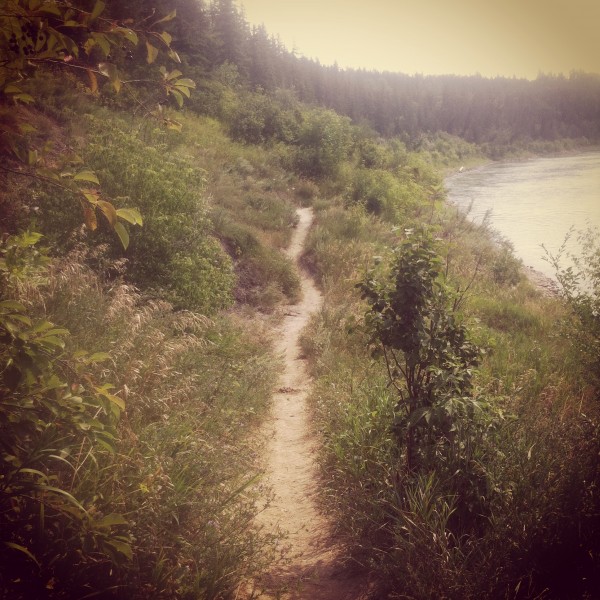
 I have been thinking, for years, about pain. Trying to tell myself a story about it. Writing a novel about it. Every poem, every essay, every walk along the river, is a part of the conversation I’ve been having with it. I have known the wrenching pain of grief for loved ones, the positive but annihilating pain and pressure of labour, the entirely different pain-as-jubilation of birth itself. I have known migraines, loneliness, the vicarious pain of witness, the tenderness of compassion, the misery of demoralization, despair. And this is what I’ve come to. Each pain is its own intelligence of the world.
In recent weeks, I have been undone by private pain and by reports of pain from other places, other people. Lately I’ve felt like pain is the whole story, or most of it, instead of seeing the spectrum along which pain sits as one (but only one) form of essential information about what life is, who we are as creatures. Will I ever learn—though each time I think I have learned—to trust the necessary, tidal work of grief? To believe that what sweeps me up and carries me away from myself, what wears away the ground, will also bear me to the only home that is possible now? To the present? What’s given?
After each shipwreck, we build a better boat, or drown. Pain is the blueprint for the better boat, but it’s etched in a braille of nerves, a scrambled code we might never manage to read. I want to build the boat, tell the story. I don’t want to be with the pain. So it goes. So each pain is made worse by the effort to escape it. So compassion begins, but not until we learn to touch, first, what is untouchable in ourselves. Then others. That’s the way this goes. And so gratitude begins. For in our pain we are at the mercy of everything.
Humility begins when there is no boat, no story—not yet.
There will always be times when we are undone by our circumstances—perhaps by a single, devastating blow, or by its aftermath, or else by trivial accumulations, cumulative weight. Often the unmooring is sudden, perplexing. Pain, like any other natural phenomenon, does not always behave in predictable ways—though I do think how pain behaves (and how we behave in pain) is often intelligible after the fact, and the effort to understand and learn from pain can offer hope of change, improvement in the circumstances. But as anyone who has suffered severe pain of any kind over any length of time knows, sometimes it’s just not possible to get there, to that place of hope. In these times of unmooring, of deep destabilization, in these precious but brutal times, we truly are at the mercy of everything else, of what is not in our control.
Recently, I’ve struggled in ways that remind me of what, in labour, is called “coupling.” Contractions that land one on top of the other, without rest—the last ditch effort of a uterus to unstick something that has become perilously stuck. (If you can’t get something loose by applying reasonable effort, you might panic and start yanking.) So, in an effort to improve the affect of my circumstances, I’ve been taking myself walking. Though I should know by now how restorative it can be to be so close to nature, to return oneself to habitat, I’ve still been surprised by how profoundly and immediately my truculent misery has responded to the simple adjacency of the river. The dried-mud paths, the shrubs and trees that grow along the paths and whose summer incarnations are beginning to blush, to shrivel, to darken—to turn toward fall—these are all medicinal in some profound way that is the opposite of self-medication. None of this anaesthetizes the wound. Rather, it restores health to the organism as a whole.
All the heads of the fireweed have fallen down now, been blown away, so there is no trace anymore even of the white puffs of seeds that appear after blossoms go. I know August in Alberta like I know August nowhere else on earth. I have walked here with my grief, in this season, time and time again. Among wolf willow and red osier dogwood, the trembling leaves of aspen, yellow sow thistle, triune leaves of sarsasparilla, black-pointed eyes of snow berries. The seasonality of things here is an embodied consolation. Reliable recurrences, natural cycles. I find these things reassuring in the way of family rituals sustained over generations, which I see in the lives of others and find beautiful, imagine to be deeply nourishing.
If culture—family culture, the broader culture—lacks continuity—as it does for many of us—if it lacks sustained and sustaining rituals that help us absorb and survive all the discontinuity—all the private untimely death and public avoidable but unaverted disaster—if we have nothing to do with our pain other than suffer through it alone—what will we do with our increasingly uninhabitable lives?
From the Latin root habitare, to dwell: Inhabit. Habitat. Habituate. Habit. Uninhabitable.
To live here. To be where we are. How?
Summer is leaking out of things. Even the goldenrod has passed its prime. The rosebushes are empty even of the dried remnants of their blooms and many of the rosehips have begun to shrink and darken. The chlorophylls in the long grasses are no longer being replenished, so their splayed blades are streaked with red and purple, but not yet with yellow. To walk along the river now is to witness the turning of the season, to be present to the arrival of survivable changes. Changes we can live with.
Though the grasses glow with their own undoing, nothing need be mourned.
Where, in our cities, is the comparable art? What artifice exists to remind us of what we, in nature, know?
To live in a culture separate from the rhythms of nature, from rituals that encode a collective response to these rhythms, is to be deprived of basic consolations. What would a culture more attuned to loss, and pain, and death look like, at the street-level? A culture that puts pain back into the spectrum of things we might reasonably expect to experience, even sometimes at length, instead of pathologizing these things and the people who experience them? A culture more adept at living with pain, inhabiting it, and co-habitating with it, when it inevitably arises. A culture too robust for nihilistic aversions to whole aspects of the life cycle.
What is this pain saying, in its deep intelligence? What kind of a pain is it? What does it feel like?
What does your pain feel like? What do you think might help?
4 responses to “On listening to pain”
Thank you, Lisa. Here the goldenrods, the milkweed, the queen Anne’s Lace – are swaying. Everything is going to seed, and the leaves are turning towards winter – all to the long tremulous pitch of crickets. What we need is a path and companionship, isn’t it. Thank you for sharing both with me – and for sharing such beautiful inspiration with all of us in this imagined place, so real. Thank you for the way you listen to pain, and tune that listening into wisdom here, for us. What does my pain feel like? A horse kicking me from the inside, I suppose. What might help? You! Good writing, which is always companionship. And maybe someone could feed that damn horse an apple.
Thank you, Jessica. A path and companionship, indeed. You are an excellent travelling companion. I have some apples for you…
Thank you for this post Lisa. I share some of the same nature with you, and it balances and eases me in every way. I’ve always turned to wilderness for solace so this past year or so when I didn’t have the energy to be out and about was very difficult. I had to sit with my unknowing, my not doing, my discomfort indoors and try to find a way through. Fortunately I had some very good friends who seemed to know when to listen and when to distract me. And I let myself go to them or call them out as I needed them. And in my difficulty I learned (of course) that there are others who live with various degrees and types of pain. We actually began getting together to talk about some things. It was great. But there are still the unspoken feelings, the loneliness, the confusion. I’m not sure how society can overcome this silence – that all is well. Pain (like death) is part of life. Your comment – “each pain is its own intelligence of the world” is very wise. If only we can retain some of that wisdom. Often once the incident passes we chose to forget it and all its associations. Its easier or something. I am hoping to retain this place I have reached. I have discovered the cause of my physical discomfort and it will pass, but the place I have reached through this doorway has things I would carry with me when I leave this room. Thank you for your words. I’ll be enjoying more of your posts.
Thank you, Carla. We do forget, and remember, don’t we? “The place I have reached through this doorway has things I would carry with me when I leave this room.” Yes.