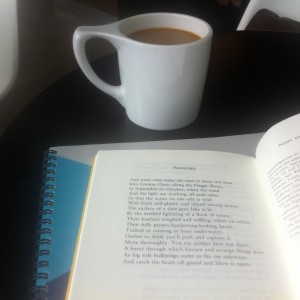
 Today is the last work day of the summer months for me. It’s been a strange, amazing, unexpected, inimitable summer. Rough and exquisite. I’m ending it with Seamus Heaney at my favourite public workplace with a great cup of coffee. The last poem in Heaney’s 1996 collection The Spirit Level is called “Postscript.” I ordered my copy of this particular collection entirely on the strength of this one poem. Some day, I will “make the time to drive out west / Into County Clare, along the Flaggy Shore, / In September or October…” In the meantime, I’m reading Seamus Heaney at the approach of fall, and considering my own postscripts to summer. This season has been nourishing and difficult, as ephemeral in its beauty as “the earthed lightning of a flock of swans.”
When I was a girl, writing letters to my distant grandparents, for a time I wrote P.S. at the end of each letter, faithfully, as they did in their letters to me. Since I hadn’t noticed that their P.S.’s were used to introduce hastily appended messages, I left my P.S.’s hanging, scriptless, an unwitting irony. I thought the letters were meaningful in themselves–like xo–a valediction in their own right. At that age, I was in the habit of reading beyond my level, in more ways than one. I knew how to run, quite happily, with only a provisional understanding. If pushed, I would have said the “P.S.” I pencilled at the end of each letter to my grandparents meant something like “Please write back.”
Until the day my mom looked over my shoulder and pointed out I had forgotten to add a message, my postscripts to my grandparents went out blank–intending one thing (desire for reciprocation), but implying another (forgetfulness).
Now I think this childhood misunderstanding–or pre-understanding–is an excellent metaphor, especially at this change of seasons, for everything we do not yet fully apprehend. And how okay that is, how lovely, and how we should treasure it. The way my daughter’s father and I refused for years to correct her misnomer for “hornets.” She called them “hormorants,” a charming conflation of hornet with “cormorant.” With our children, we treasure each incremental, partial understanding for its particularity, its ephemeral beauty, its own strange truth. Why not with ourselves?
How I would love to lose my adult anxiety, apprehensiveness, about the unknown–to exchange it for my childhood enthusiasm for each provisional experiment. Or at least to split the difference. I want to get curious, excited by what I discover, even if part of what I find is that I’ve been making an embarrassing mistake.
For everything that falls away, that we lose, what do we gain? What gain in this loss? What now? Aren’t these the questions the forced resilience of the lifelong relentless changing of seasons ought finally to teach us to ask elsewhere, and anywhere, of anything?
Seamus Heaney writes: “You are neither here nor there, / A hurry through which known and strange things pass”.
How lovely and sad to think of all the things that have passed through this summer, some known and some strange. All of the things that could have been added but weren’t, and won’t be. I’ve been mourning these things, in my way, but perhaps only to pry myself loose, like a leaf, to turn toward the fall.
For every provisional misunderstanding that will one day prove inadequate, what do we now know that we will then forget? And what might we celebrate in our failure to know? What might we enjoy in our beautiful errors?
I’d like to find a way to love what’s been left undone, what’s been partially understood, the mistakes that have been made. To hold onto the beautiful ephemeral evidence of a mind still working its way toward an understanding of the world, in ways that will be soon again be totally changed.
I’d like to learn to love each season’s unwritten postscripts. To appreciate in its own right whatever error of apprehension–whatever fraught hypothesis–underwrites the space opened up within a silence that would otherwise be totally undifferentiated. P.S.
It’s easy this time of year to fall into the making of ambitious, unachievable lists, to begin writing anxious pre-scriptions for the next season, as much as appending nostalgic post-scripts to the old.
But I like the possibility I knew of, for a short time, as a child, before I was corrected and gave up the habit of leaving my postscripts blank.
We could leave some spaces open. We could leave some silences to bear the freight of what we are not yet able to know, or say.
Please write back.
P.S.
2 responses to “P.S.”
A lovely thoughtful piece of writing. Thank you for it.
tk
P.S. Keep the postcripts open. Then they have the potential to be codas…
Love this, Theresa. Yes, the open p.s. as a potential coda…amazing. cheers.